 |
 |
Spirituality
and Psychology |
About this Website |
Questions and Answers About Psychotherapy |
Books |
Your Hope
|
The
Metaphor
of
Change
|
 N HIS masterful play, Man and Superman, George
Bernard Shaw turned the classical images of heaven and hell upside
down. He described hell as a place of complete
satisfaction, where all desires are freely fulfilled. Personal responsibility
had no place in hell. It did in heaven, though, a place for the “masters
of reality”—and, curiously enough, the place where souls were free
to go when they finally got sick of
hell. N HIS masterful play, Man and Superman, George
Bernard Shaw turned the classical images of heaven and hell upside
down. He described hell as a place of complete
satisfaction, where all desires are freely fulfilled. Personal responsibility
had no place in hell. It did in heaven, though, a place for the “masters
of reality”—and, curiously enough, the place where souls were free
to go when they finally got sick of
hell.
This is a provocative
metaphor. Being a metaphor, though, it is not to be taken literally in a
metaphysical
sense.[1]
But it is a good metaphor for how we live our life
in this world, because this concept of “a hell that you can leave
when you get sick of it” aptly describes psychological change as well.
Many people cling to their own psychological “hell,” no matter
how painful it may be, because the discipline of health is even more
fearful. But eventually, if they catch only a glimpse
of sorrow
for the mess they’re in, they can get sick of it all and decide to cross
over to “reality.” |
Knowledge
|
Therefore, though an
atheist, not a theologian, Shaw nevertheless made a brilliant discovery:
a spiritual life is also a practical life. Yet such practicality does
not depend on knowledge so much as
understanding.
Too many persons
today, however, preoccupy themselves with knowledge, whether it be intellectual
or carnal, and in doing so they sidestep the concept of understanding. Why?
Because understanding involves “standing under something,” and
that something is the “law”—not the local penal code, but
the psychological law of lack and limitation that holds the agony of
being itself as it stands on the brink of redemption through divine
love. All the pages of knowledge flap uselessly in the swirling gusts that
blow along that ridge. |
Not
Knowing
|
This lack and limitation
affects every child born into this world, because we are all born into a
pre-existing social world of language, science, technology, art, literature,
and so on that excludes us and mystifies us. But even more profound than
the mystery of the sum total of all this factual information is the mystery
of the child’s own body. The child finds itself literally at the mercy
of biological processes—eating, vomiting, defecation, urination, bleeding,
reproduction, and death—that it can neither control nor comprehend.
Thus the child will feel excluded and will believe—rightly so—that
the world “knows” something that he or she does not know. Right
from the beginning, then, the child is located in a profound emotional space
of “not knowing” and feeling “left
out.”
Moreover, when
children are criticized and humiliated by others, they can develop the belief
that others are deliberately withholding knowledge from them, and
this belief can cause the children to burn with anger
at their parents in particular and the world in general. Such children can
develop an intense desperation to want to figure out everything in advance,
before risking doing anything, so as to avoid further feelings of
humiliation.
|
Knowing—that
is, anticipating—what might happen next is a characteristic defensive
desire of children in dysfunctional families. After all, if they can guess
an irrational parent’s next move, they might be able to avoid an ugly
family scene.
To such children,
then, it’s a loathsome thing to admit, “I don’t
know.”
This explains
why, if you offer some piece of information to a person who grew up in a
dysfunctional family, his or her response will likely not be a simple
“Thank you” but will be a quickly retorted “I
know!” |
|
It’s an
awkward, uncomfortable, and frustrating place to be—and so we all devote
considerable energy to overcoming the feeling of “not
knowing.”
• |
We might seek out
intellectual knowledge through formal education. |
• |
We might engage in
scientific research. |
• |
We might join country
clubs, gangs, cults, cliques, or any other social organization that purports
to offer some secret “knowledge.” |
• |
We might search through
myriads of pornographic images hoping for the special privilege of seeing
what is usually kept hidden. |
•
|
We might seek out
“carnal knowledge” through the body of another person and attempt
to locate the psychological agony of our bodily mystery in the
pleasure—or pain—of the other. |
• |
We might create our
own fantasy worlds—with thoughts and images of eroticism, heroism, revenge,
or destruction—in which we can “figure it out” on our own
so as to possess the power and recognition we so desperately crave. |
|
The
Veil
|
However much we might
desire it, all the “knowledge” in the world is nothing but a thin
veil that hangs over the dark anguish of helplessly “not knowing.”
Standing before the veil, suspecting the secret truth
of our “not knowing,” we feel confused, disgusted, weak, useless,
and deceived.
|
The brilliant
French psychoanalyst, Jacques Lacan, in The Four Fundamental Concepts
of Psycho-Analysis, tells the story of a competition
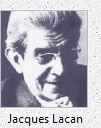 between two ancient painters, Zeuxis and
Parrhasios.[2] Zeuxis receives acclaim for painting grapes so life-like
that even the birds who try to peck at them are fooled. In his pride, Zeuxis
then goes to look at the work of Parrhasios. But Zeuxis sees only a veil,
and so he asks to see the painting that Parrhasios has hidden behind the
veil. Well, Parrhasios’ painting was the veil. It was so well
done that it fooled even the master of deceptive painting himself. Hence
Lacan points out that if you want to deceive someone, present him with a
“veil,” something that incites his pride to want to know what is
being hidden from him.
between two ancient painters, Zeuxis and
Parrhasios.[2] Zeuxis receives acclaim for painting grapes so life-like
that even the birds who try to peck at them are fooled. In his pride, Zeuxis
then goes to look at the work of Parrhasios. But Zeuxis sees only a veil,
and so he asks to see the painting that Parrhasios has hidden behind the
veil. Well, Parrhasios’ painting was the veil. It was so well
done that it fooled even the master of deceptive painting himself. Hence
Lacan points out that if you want to deceive someone, present him with a
“veil,” something that incites his pride to want to know what is
being hidden from him. |
|
With all of our
knowledge hanging like a deceptive veil over the agony of being, we stand
helplessly under the psychological law of lack and limitation. Trapped in
this wretched state, therefore, we have only one hope: to understand the
soul. |
Loss
Of
Soul
|
Psychologically speaking, to paraphrase
Lacan,[3] soul is
something—alien to the
mundane—that empowers us to bear what is intolerable and lacking in
the human
world.[4]
In this modern
world, though, much of our society has lost its sense of soul. In the collective
desire for diversity it’s all too easy to misunderstand life by confusing
the truth of tolerance with the fraud of acceptance, the truth
of holiness with the fraud of pride, and the truth of
love
with the fraud of sensuality.
Furthermore,
with the loss of soul many of us today have also discarded the concept of
sin—which, in psychological language, can be defined as a
functional narcissism in all of us which serves the self, rather than
others. So, instead of making life’s decisions according to personal
responsibility, we make decisions according to personal convenience. Sin,
therefore, is what blinds us to the realization that there’s more to
life than the veil of the psychological “self” that the world shows
us as the coveted image of happiness. As such, sin pulls us away from true
love and sucks us down into the hedonistic mire of narcissism—and there,
in that foul netherworld, soul is lost. Sin may be convenient, but it’s
just not practical.
|
The great theologian
Augustine of Hippo, in north Africa, said that “Sin is the punishment
of sin.” This makes perfect sense if you understand that the human social
world is nothing but a mass of psychological
defenses—pride, anger, competition, social status, take your
pick—which protect us in our blindness, the blindness that results from
an ignorance of soul. All defenses originate in childhood as ways to assist
survival, but carried on unconsciously into adulthood
those same defenses—the ones that once protected us—lead us into
nothing but the repeated punishment of psychological
and social dysfunction.
Don’t
misunderstand this. We are all basically good, but we are all subject to
temptation by evil. Goodness takes work—lots of work. Hard work. And
self-restraint. For without our restraining the pride
of self and its defenses, true love, the most exquisite
and pure love imaginable, remains invisible. Along the path of least
resistance—the path of sin, the easy way, the
way to nowhere—love is nowhere to be seen, for it remains banished behind
the thorny hedges of psychological defenses.
And what is true love, if not to give of yourself to save others—even
those who hate you— from their blindness? |
|
|
Beyond
Lack
and
Limitation
|
Jacques Lacan, in his writing (see
the book Feminine Sexuality: Jacques Lacan and the école freudienne and
the chapters “God and the Jouissance of The Woman” and “A Love Letter”) speaks of
the psychoanalytic concept of “lack.” Although he uses some complicated mathematical
imagery and abstruse psychoanalytic language to describe the matter, this concept of
“lack” could be summed up theologically by saying that we cope psychologically with
our human brokenness—that is, our separation from God—by using
illusions to create
for ourselves experiences of comfort in the midst of our misery. The illusions are
varied, such as food, drugs, romance fantasies, sexual activity, sports, militarism,
and politics, and the comfort can take the form of pleasure, pain relief, social
acceptance, and personal valuation.
Lacan points out that one
“side” of life is characterized by the use of this dynamic of illusions/comfort as an
unconscious compensation for our brokenness. Moreover, Lacan
demonstrates that there is another “side” of life that isn’t trapped in lack but that
experiences something very real, albeit “unknown.” Lacan speaks of this experience as
something that some women have encountered; it’s an ecstasy they experience without
knowing what it is, and so Lacan refers to it as something “beyond sex” and thus as
something mystical. Furthermore, Lacan states that even though most men are trapped
on the “lack” side of life, some of them also encounter the mystical experience.
Note carefully that Lacan spoke
as a psychoanalyst who was concerned with issues of neuroticism and sexuality, and so he
didn’t elaborate on his ideas as spiritual concepts. Nevertheless, to speak spiritually,
it can be said that the side of life not trapped in lack is the place of mystical religious
experience, and that it is characterized not by futile efforts of compensation for what
is lacking but by a real experience of a fulfillment of a yearning for God.
Hence we can define
mystical ecstasy as a prescient experience of a complete union with God.
Because the mystical experience
is beyond sex, both men and women can be mystics; nevertheless,
more women than men tend to have mystical experiences. This can be explained by the fact that
anyone who preoccupies himself or herself with illusions of compensation is obstructing the
mystical experience. In the past this was true of most men, and it is still true of most men
today. And, in the past, many women were not drawn to these illusions. But today, sadly, more
and more women are being “liberated” into sin and are crossing over into the use of illusions
typically used by men.
Nevertheless, women who value the
supernatural—rather than shake it off as a burden—can have a special role in their spiritual
influence on men. Both men and women are prone to all illusions as a fact of life. Women,
however, can access the fullness of feminine nature when women seek the mystic way of life—that
is, a way of life governed not by an attempt to compensate for lack and limitation but by
renouncing illusions for the sake of an experience that is beyond sex, and so they take up a
spiritual authority to relate to men with a real love that puts men
in their proper spiritual place of loving God rather than loving illusions.
Consequently, the containment of
men’s proclivity to using illusions of compensation can take place through the supernatural
help of women yearning for the mystic life. Thus when both women and men seek the supernatural
side of life they participate in an equality that trite illusions can never attain.
|
Meaningful
Direction
|
We would
do well, then, to pay attention to sin today while remembering that crossing
the barrier between sin and spirituality is a simple matter of personal choice,
with complete freedom to go in either direction. Psychology has too
often been preoccupied with the pursuit of
happiness,[5]
and it has missed the point about helping individuals understand life and
find a personally meaningful—and practical—sense of
direction.[6]
Psychology in itself cannot offer any meaning to
life,[7]
but it can help individuals disentangle themselves from the snare of illusory
social
identifications that keep us trapped in blindness and pull us backwards
into the insanity of self-destruction.
|
When a society turns
its back on God, it abandons truth, and, when truth is abandoned, anything and everything,
even insanity itself, is accepted in the name of tolerance. Thus the society becomes a
culture of insanity. |
|
I can offer no
“proof” of God, nor can I prove that souls exist or that spirituality
is anything more than a figment of our imaginations. But look at it this
way: If you value spirituality, what do you have to lose? Mediocrity. What
do you have to gain? Everything.
But the proof
of love is simple:
Gustato spiritu,
desipit omnis
caro.[8]
(Once
I taste of the spirit, all carnal things become
meaningless.) |
The
Book
|
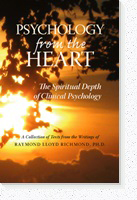 Psychology from the
Heart Psychology from the
Heart
The Spiritual Depth of Clinical Psychology
A collection of
texts from the writings of
Raymond Lloyd Richmond, Ph.D.
More
information |
Gratitude
|
Has this web page been helpful? Then please help support this
website in gratitude, as a “down-payment” on the success of your
hopes and dreams!
|

Notes:
1.
The real hell is a truly horrifying place because it is, literally, the
defilement of true love. St. Teresa of Avila,
who had a vision of hell, wrote that she would be willing to suffer the pain
of several deaths if it would prevent anyone from going there. See St.
Teresa of Avila, “The Book of Her Life.” In The Collected Works
of St. Teresa of Avila, Volume Two, trans. K. Kavanaugh and O. Rodriguez
(Washington, DC: ICS Publications, 1980), ch. 32, no. 6:
“From this experience [the vision
of hell] also flow the great impulses to help souls and the extraordinary
pain that is caused me by the many that are condemned. . . .
It seems certain to me that in order to free one alone from such appalling
torments I would suffer many deaths very willingly.”
2. Jacques Lacan,
“The Four Fundamental Concepts of Psycho-Analysis.” Edited by
Jacques-Alain Miller, translated by Alan Sheridan. (New York: W. W. Norton,
1981). See p. 103 and pp. 111-112.
3. Jacques Lacan,
“A Love Letter.” In Mitchell, J. & Rose, J. (Eds.), Feminine
Sexuality: Jacques Lacan and the école freudienne. (New York:
W. W. Norton [paperback], 1985). See p. 155:
“And yet I fail to see why the fact
of having a soul should be a scandal for thought—were it true. If it
were true, the soul could only be spoken as whatever enables a being
. . . to bear what is intolerable in its world, which presumes
this soul to be alien to that
world. . . .”
4. Please note
that the psychological meaning of “soul” is one thing, whereas
the theological meaning (and welfare) of the soul is a matter for
religion, which can be a transcendent step above spirituality. That is, some
spirituality, in its aspiration for a “oneness” with the universe,
often inadvertently becomes a oneness with sin as well. Religion, if its
spirituality seeks a moral responsibility to the divine, can transcend moral
relativism. Sadly, though, some individuals make their religious practices
into mere intellectualism lacking in spirituality.
5. Jacques Lacan,
“The signification of the phallus.” In Écrits: A
selection, trans. Alan Sheridan (New York: W. W. Norton, 1977). See p.
287:
“In any case, man cannot aim at
being whole (the ‘total personality’ is another of the deviant
premises of modern psychotherapy), while ever the play of displacement and
condensation to which he is doomed in the exercise of his functions marks
his relation as as subject to the signifier.”
6. “Wait
a minute,” you say, “the motto of this country is In God We
Trust. America is a spiritual country.” Well, we can wonder about
that. How can the pursuit of “happiness”—with its narcissistic
hunger for aggressive political hostility and sniping, angry and hateful
protest, violent video games, competitive sports, erotic entertainment, obesity,
drugs, gambling, social rudeness, exploitation of the underprivileged, abuse
of the environment, and institutional hate crimes against unborn
children—be spiritual?
7. Lacan, at least,
did not attempt to subvert religion like Freud, nor did he try to
“psychologize” religion like Jung and Rank. Lacan simply respected
the fact that psychoanalysis could say nothing meaningful about religion.
See “The subversion of the subject and the dialectic of desire in the
Freudian unconscious.” In Écrits: A selection (Alan Sheridan,
Trans.). New York: W. W. Norton, 1977, p. 316:
“We [psychoanalysts] are answerable
to no ultimate truth; we are neither for nor against any particular
religion.”
8. I found this
quote in The Ascent of Mount Carmel by Saint John of the Cross, Book
Two, Chapter 17, no. 5. (The English translation is my own.) Saint
John refers to it as “a frequently quoted spiritual axiom.” Saint
Bonaventure, in his Commentaria in Quatuor Libros Sententiarum attributes
the quote to Pope Saint Gregory the Great (see Opera Omnia S. Bonaventurae,
Ad Claras Aquas, 1882, Vol. 1, p. 254), though the quote may actually have
its origin in a letter (Epistle 111) by Saint Bernard of Clairvaux.
Additional
Resources
Lacan:
The Lacanian School
of Psychoanalysis in the San Francisco Bay area, offers training
in Lacanian psychoanalysis.
The San Francisco Society
for Lacanian Studies provides lectures and information about Lacanian
psychoanalysis.
Related pages within A Guide to Psychology
and its Practice:
Death—and
the Seduction of Despair
Fear
Forgiveness
Identity and
Loneliness
Questions and Answers
about Psychotherapy
Sexuality and
Love
Spiritual
Healing
Terrorism and
Psychology
CONTACT ME
INDEX of all subjects
on this website
SEARCH this
website |
|
A Guide
to Psychology and its Practice |
www.GuideToPsychology.com |
|
Copyright © 1997-2021 Raymond
Lloyd Richmond, Ph.D. All rights reserved.
San Francisco |
|
All material on this website is
copyrighted. You may copy or print selections for your private, personal
use only.
Any other reproduction or distribution without my
permission is prohibited. |
|
|